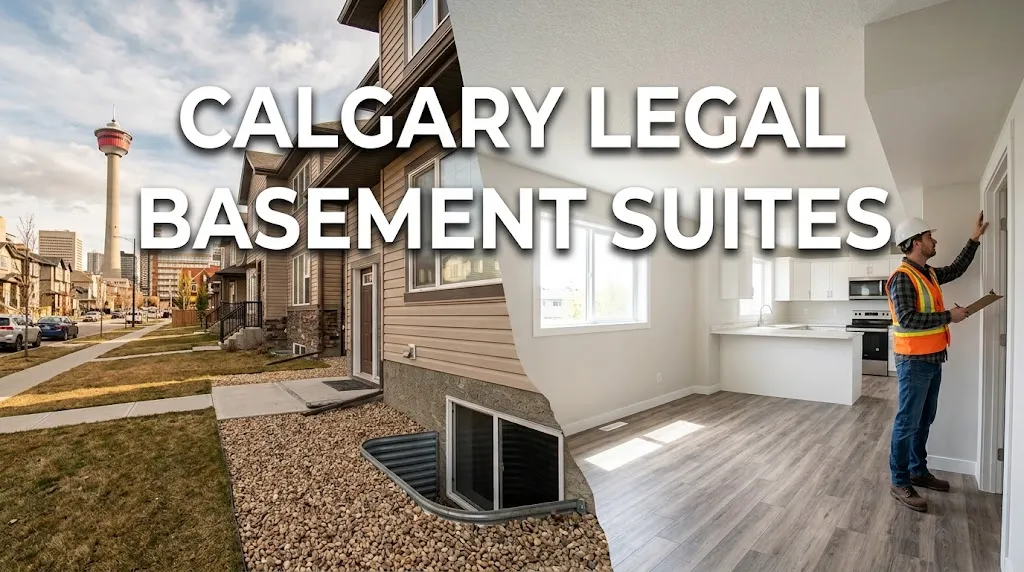
Calgary Legal Basement Suites: Rules, Costs & Rental Income
Calgary Legal Basement Suites: Rules, Costs, and Mortgage Helper Strategies
Key Takeaways
A legal secondary suite in Calgary must meet strict Alberta Building Code safety standards, pass municipal trade inspections, and hold active registration on the City of Calgary Secondary Suite Registry.
Lenders accept up to 100% of legal secondary suite rental income to offset borrowing ratios under the B-20 OSFI mortgage stress test, boosting your total purchasing power.
The City of Calgary’s Secondary Suite Amnesty Program waives Development Permit and registration fees for existing suites built prior to March 12, 2018, until December 31, 2026.
What Makes a Basement Suite Fully Legal in Calgary?
A basement suite in Calgary is considered legal when it satisfies the Alberta Building Code, passes municipal fire and electrical inspections, and is listed on the public City of Calgary Secondary Suite Registry.
Buying a property advertised as having a "basement suite" requires verifying its legal status early in your search. In Calgary, many lower-level units are illegal or non-conforming, meaning they were built without proper permits or life-safety measures.
Essential Alberta Building Code Life-Safety Rules
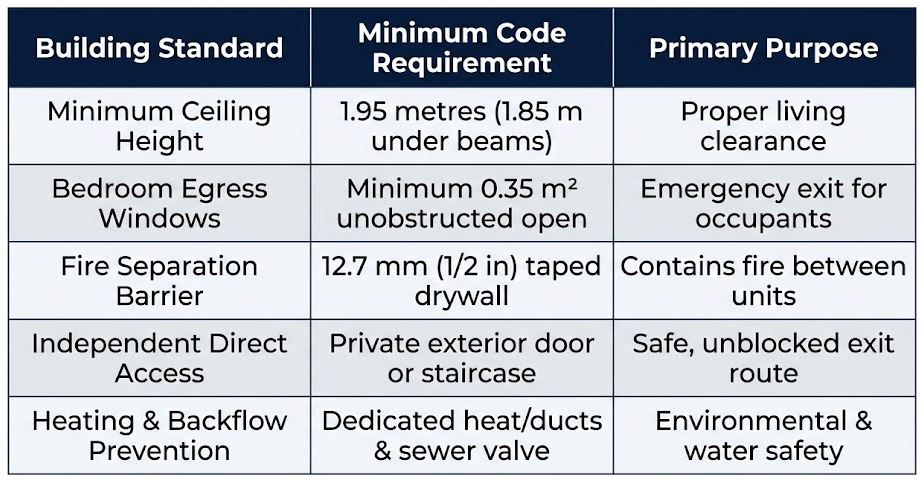
To obtain legal status, a basement suite must satisfy core construction criteria:
Egress Windows: Every bedroom in a secondary suite requires at least one exterior window that opens from the inside without tools or special knowledge. The opening must provide an unobstructed area of at least 0.35 square metres with no dimension smaller than 380 millimetres.
Ceiling Heights: The minimum floor-to-ceiling height across living areas is 1.95 metres. Drops down to 1.85 metres are permitted directly beneath localized ductwork or structural beams.
Fire Containment Barriers: Drywall measuring at least 12.7 millimetres (1/2 inch) must be installed on the ceiling and shared walls separating the main home from the basement suite. All seams must be taped and mudded to form a smoke-tight barrier. Connecting doors between units must be solid wood or metal with a minimum thickness of 45 millimetres and equipped with a self-closing device.
Interconnected Smoke and CO Alarms: Smoke and carbon monoxide detectors must be hardwired and interconnected so that an alarm sounding in the basement instantly triggers the units on the main floor.
Electrical and Mechanical Requirements: An electrical load calculation must confirm the home has sufficient amperage (typically 100-amp or 200-amp service managed through ENMAX). Mechanical systems must include backflow preventer valves on main sewer lines to guard against basement backup.
The City of Calgary Secondary Suite Amnesty Program
Homeowners or buyers who own properties with existing, unregistered basement suites constructed prior to March 12, 2018, can take advantage of the City of Calgary’s Secondary Suite Amnesty Program. Active through December 31, 2026, this program waives Development Permit and registry fees—saving property owners approximately $741 in municipal charges while establishing a clear compliance path.
How Does a Legal Secondary Suite Help You Qualify for a Mortgage?
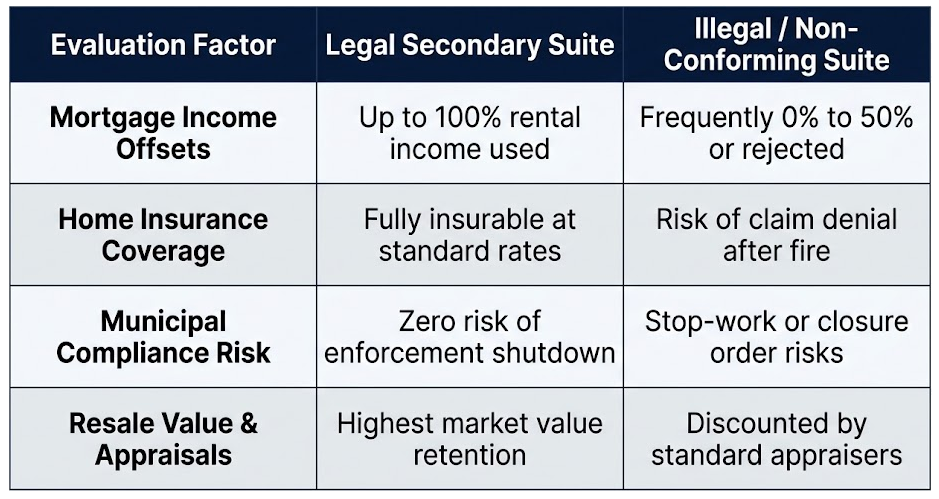
Canadian mortgage lenders can apply up to 100% of projected rental income from a legal secondary suite to reduce your debt-service ratios during the B-20 OSFI mortgage stress test.
Using a legal basement suite as a "mortgage helper" allows home buyers to bridge affordability gaps in competitive Calgary communities. When applying for a mortgage through major Canadian chartered banks or monoline lenders, rental income from a legal suite is factored directly into your qualification calculations.
Debt-Service Ratio Calculation
Lenders evaluate two primary debt ratios under Office of the Superintendent of Financial Institutions (OSFI) guidelines: Gross Debt Service (GDS) and Total Debt Service (TDS).
Gross Debt Service (GDS): Capped typically at 39% of gross household income. Covers mortgage principal, interest, property taxes, and heating.
Total Debt Service (TDS): Capped typically at 44% of gross household income. Covers housing costs plus all external debts like auto loans and credit cards.
When you purchase a home with a legal secondary suite, an appraiser verifies market rental rates for the lower unit. Lenders add a significant portion of that projected rental income directly onto your baseline gross income. This lowers your calculated debt-service ratios, enabling you to qualify for a higher total mortgage or purchase a detached property in higher-demand Calgary neighbourhoods such as Martindale, Signal Hill, Varsity, or Evanston.
What Are the Financial Advantages for Ontario Buyers Relocating to Calgary?
Buying a home with a legal secondary suite in Calgary yields strong rental cash flow while eliminating Ontario's costly provincial land transfer tax at closing.
Out-of-province buyers relocating from the Greater Toronto Area or Southern Ontario frequently purchase single-family homes with basement suites to stabilize their monthly housing expenses. The combination of lower purchase pricing, steady rental demand, and tax efficiency makes Calgary an attractive target for residential capital.
Zero Provincial Land Transfer Tax
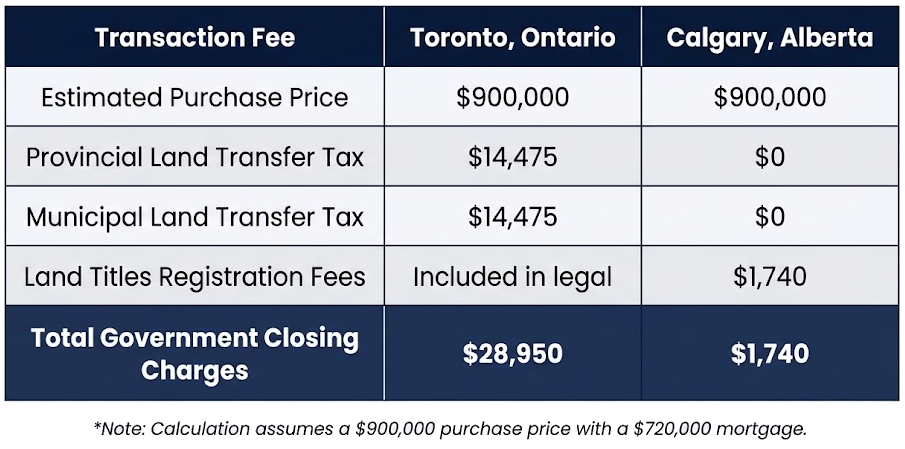
In Ontario, purchasing a $900,000 single-family property triggers significant land transfer taxes—and double that amount inside Toronto city limits. Alberta does not charge a provincial land transfer tax.
Instead, Alberta registers title updates through the Alberta Land Titles office using a low flat-plus-variable fee schedule:
Land Titles Transfer Fee: $50 base fee plus $5 per $5,000 of property value.
Mortgage Registration Fee: $50 base fee plus $5 per $5,000 of registered mortgage amount.
On a 900,000purchasewith20%down(720,000 mortgage), government closing costs in Alberta total just $1,740. Leaving over $27,000 of capital in your pocket at closing provides immediate liquidity to furnish the main home, make cosmetic updates, or build a cash reserve for tenant turnovers.
Citywide Zoning Support (R-CG Framework)
The City of Calgary’s R-CG (Residential, Grade-Oriented Infill) zoning rules simplify secondary suite approvals across established suburbs. Combined with low vacancy rates reported across Calgary Real Estate Board (CREB®) market statistics, detached properties with legal lower units represent one of the most stable dual-purpose housing models in Alberta.
Frequently Asked Questions
How do I verify if a Calgary basement suite is officially legal?
You can confirm if a secondary suite is legal by searching the property's address on the official City of Calgary Secondary Suite Registry map online. If the property is listed, it has successfully passed all municipal building inspections and safety checks.
How much does it cost to build or legalize a basement suite in Calgary?
Legalizing an existing suite under the Secondary Suite Amnesty Program generally costs between $2,500 and $10,000 for minor safety retrofits like egress windows, drywall sealing, and interconnected smoke alarms. Building a brand-new legal basement suite from scratch typically ranges from $50,000 to $85,000 depending on square footage, plumbing rough-ins, and finish quality.
Can I build a legal secondary suite on any residential property in Calgary?
Most residential lots in Calgary permit secondary suites under current municipal land-use rules, provided the property meets Alberta Building Code requirements for ceiling heights, egress windows, fire separation, and private entry access. Properties subject to restrictive covenants or specific condo bylaws may carry additional private restrictions.
Moving to Calgary or Planning Your Next Move?
Analyzing legal basement suites demands clarity on municipal codes, rental valuations, and mortgage underwriting rules. As dual-licensed REALTORS® in Alberta and Ontario, Quynh Tran and Dominika Sliwinska at Q Real Estate Group simplify property searches across both provinces—helping buyers identify compliant secondary suites and execute coordinated moves with complete confidence.
Looking for detailed community profiles and step-by-step buyer strategies? Download our comprehensive Q Real Estate Group Buyer's Guide. If you are preparing to list your current home in Ontario or Alberta to fund your next real estate move, access our Q Real Estate Group Seller's Guide to maximize your property's net proceeds.