
Calgary Real Estate Investment Guide | Cash Flow & Yields
Investing in Calgary Real Estate: Cash Flow, Yields, and Strategy
Key Takeaways
Strong interprovincial population influx and economic diversification drive consistent rental demand across Calgary suburban corridors.
Legal secondary basement suites allow property investors to generate dual income streams under a single land title, maximizing gross rental yields.
Alberta's business-friendly environment features zero provincial sales tax, no landlord rent caps, and zero provincial land transfer taxes.
Why Is Calgary Attracting Real Estate Investors from Across Canada?
Calgary attracts real estate investors due to strong population growth, high median household incomes, favorable landlord regulations, and lower entry pricing relative to Toronto and Vancouver.
Interprovincial migration to Alberta remains robust, driven by corporate expansions, job creation in technology, energy, and logistics, alongside favorable housing affordability ratios. For real estate investors, sustained population growth reinforces low residential rental vacancy rates across key quadrants.
Unlike provinces with restrictive rent controls, Alberta does not impose annual caps on rent increases for existing tenants upon lease renewal (provided statutory advance notice rules under the Residential Tenancies Act are followed). Coupled with zero provincial land transfer taxes and competitive property tax rates, Calgary offers a supportive operating climate for residential real estate portfolios.
How Do Legal Secondary Suites Impact Investment Cash Flow in Calgary?
Properties featuring city-permitted legal secondary suites increase gross rental revenues by accommodating two independent tenants on one property title.
In Calgary, single-family detached homes equipped with legal basement suites generate two distinct monthly rental payments. The upper floor typically rents to families or working professionals, while the basement suite serves single occupants or couples.
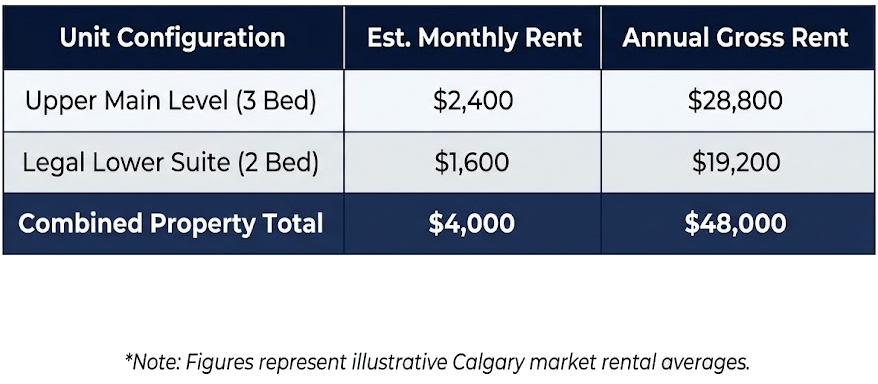
City of Calgary municipal bylaws outline clear criteria for secondary suites, including dedicated exterior entrances, independent heating/ventilation controls, egress windows, fire-rated drywall barriers, and interconnected smoke alarms. Purchasing existing legal suites or retrofitting compliant properties adds property equity while improving debt-coverage ratios with lenders.
Which Calgary Property Types Offer the Strongest Rental Yields?
Suburban detached homes with suites and multi-story row townhomes deliver strong rental yields by combining steady long-term appreciation with manageable maintenance overhead.
When analyzing Calgary real estate options, investors evaluate income stability and asset performance across three primary categories:
Detached Homes with Legal Suites: Deliver highest gross cash-flow potential and land ownership equity. Demands higher upfront capital but attracts stable, long-term tenants in family-centric communities like Horizon, Martindale, or Legacy.
Townhomes and Row Housing: Provide strong cash-on-cash returns with lower initial purchase prices. Exterior maintenance managed through condo corporations reduces owner responsibilities.
High-Rise Apartment Condominiums: Located in Beltline, Downtown, or East Village. Offers lower purchase points and strong tenant demand from downtown professionals, balanced against higher monthly condo management fees.
Analyzing metrics like Months of Supply and Average Days on Market (DOM) from the Calgary Real Estate Board (CREB®) helps pinpoint timing across specific housing sub-sectors.
Frequently Asked Questions
Is Calgary a good place to invest in rental properties?
Yes, Calgary offers favorable real estate investment fundamentals, including strong interprovincial migration, healthy employment figures, no provincial land transfer tax, and higher average rental yields compared to major Canadian coastal markets.
Are legal secondary suites permitted across all Calgary residential zones?
The City of Calgary permits secondary suites across standard residential districts, provided the structure meets Alberta Building Code requirements, parking provisions, and municipal registration standards.
What taxes apply when purchasing investment property in Alberta?
Investors do not pay provincial land transfer tax or provincial sales tax (PST) in Alberta. Standard Federal Goods and Services Tax (GST) applies only to newly constructed properties, while standard income tax rules apply to net rental earnings.
Moving to Calgary or Planning Your Next Move?
Building a cash-flowing real estate portfolio demands reliable data, hyper-local community knowledge, and realistic financial modeling. Quynh Tran and Dominika Sliwinska at Q Real Estate Group advise local and out-of-province investors on identifying, analyzing, and acquiring high-performing properties across Calgary.
Looking to evaluate top investment communities and analyze rental cash-flow scenarios? Download our comprehensive Q Real Estate Group Buyer's Guide. If you are restructuring an existing real estate portfolio to reallocate capital, explore our Q Real Estate Group Seller's Guide for targeted listing insights.